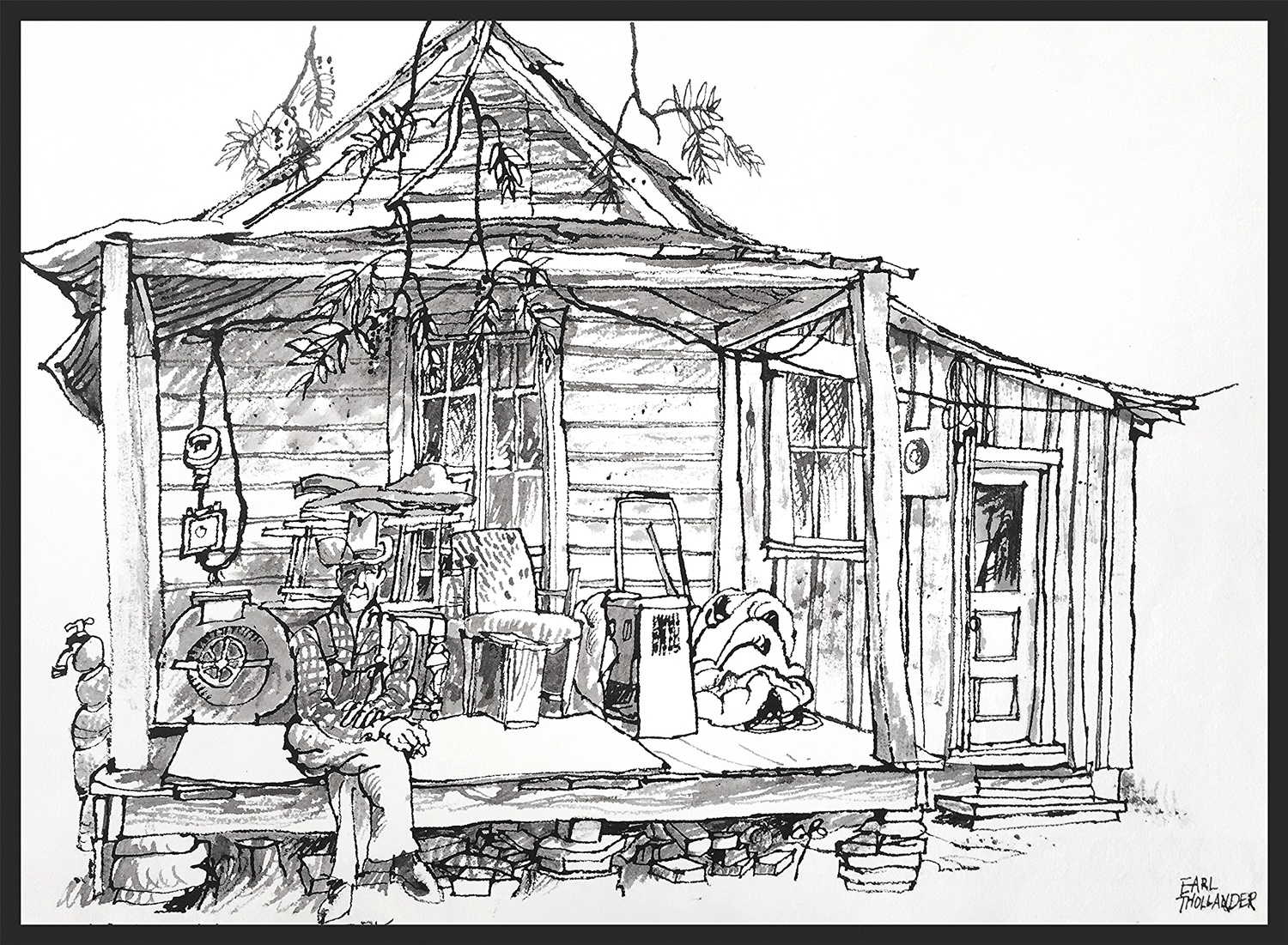
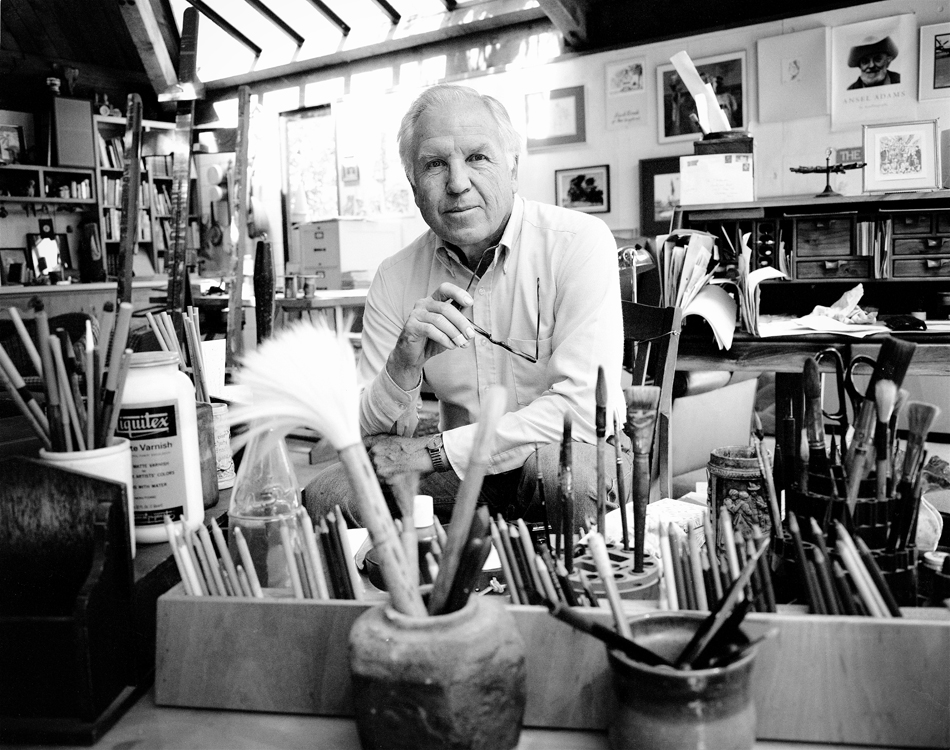
Earl Thollander
Originally from Kingsburg, California, a small city just south of Fresno, Thollander moved to San Francisco along with his family where he was educated through the public school system. He continued on in 1939 to study art at the city college. In 1944, Thollander earned a Bachelor of Arts degree from the University of California.
After graduating, Thollander served two years as a naval officer during World War II. During this time, he began to sketch and paint the places that he visited. This compelled Thollander to take classes at The Art Institute, The Academy of Art, and The Art League of California. In 1949, Thollander started his career as an illustrator by continuing his travel and sketching. Many of his drawings were used as research for book illustrations and painting.
Thollander published at least 10 books full of his sketches from his travels. He was best known for the Back Roads series, with Back Roads of California first published in 1970. The series continued on to Arizona, New England, Texas, North Carolina and South Carolina. For years, Thollander traveled around in his Chevy pickup truck and sketched the countryside.
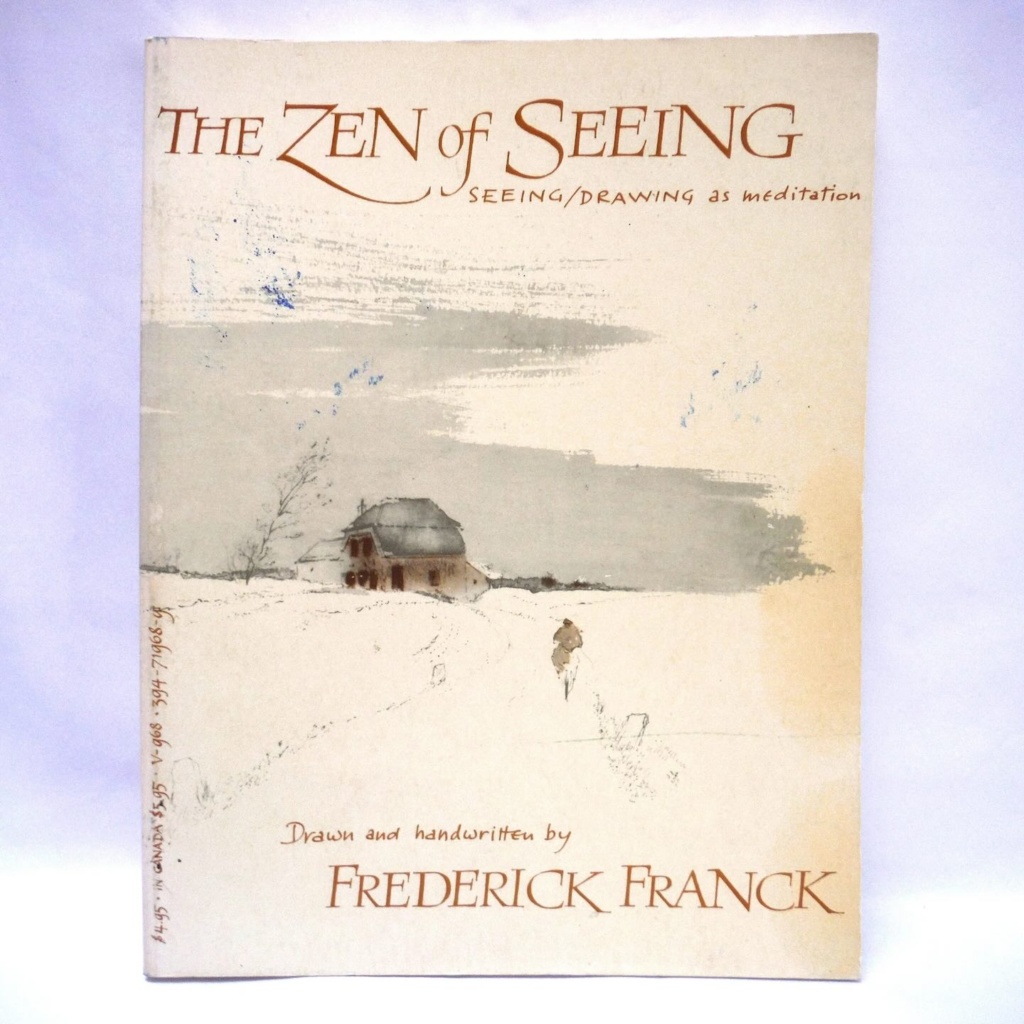
Frederick Franck
Frederick Sigfred Franck (April 12, 1909 – June 5, 2006) was a painter, sculptor, and author of more than 30 books on Buddhism and other subjects, who was known for his interest in human spirituality. He became a United States citizen in 1945. He was a dental surgeon by trade, and worked with Dr. Albert Schweitzer in Africa from 1958 to 1961.
His sculptures are in the collections of the Museum of Modern Art, the Whitney Museum of American Art, the Fogg Art Museum, the Tokyo National Museum, and the Cathedral of St. John the Divine.
His major creation was a sculpture garden and park adjacent to his home in Warwick, New York, which he called Pacem in Terris (“Peace on Earth”). In 1959, he and his wife, Claske Berndes Franck, purchased the six-acre property, the site of an old grist mill which had become a dumping ground, for $800.
They opened Pacem in Terris to the public in 1966. Dr. Franck dedicated it to Dr. Albert Schweitzer, Pope John XXIII, and the Buddhist teacher D.T. Suzuki.[3] More than 70 sculptures adorn the property, which is now operated by a nonprofit foundation.
“It is in order to really see, to see ever deeper, ever more intensely, hence to be fully aware and alive, that I draw what the Chinese call ‘The Ten Thousand Things’ around me. Drawing is the discipline by which I constantly rediscover the world. I have learned that what I have not drawn, I have never really seen, and that when I start drawing an ordinary thing, I realize how extraordinary it is, sheer miracle.” — Frederick Franck