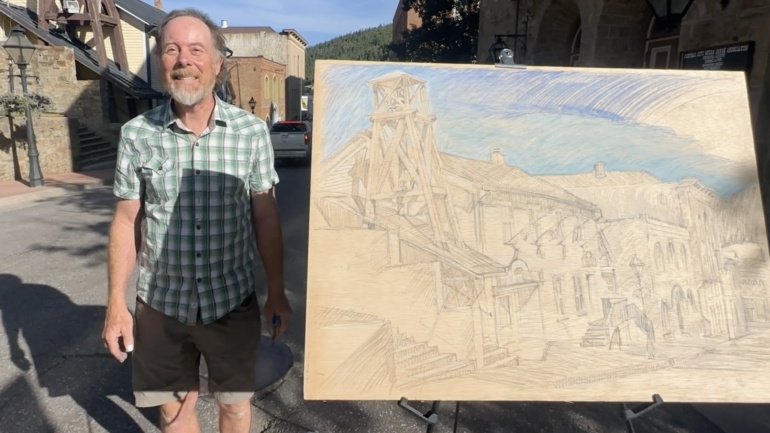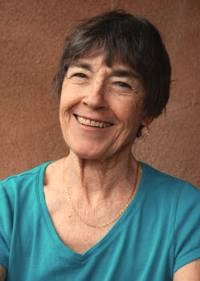
“I realized a long time ago that a lot of what painting is about is being there. That’s why I am less happy about photographing what I want to paint later. When you sit there for a while and you are drawing it or painting it, all of your senses are open to whatever that is. You see it and you feel what the air is like and the light changing and whatever noise there is–water, birds. So that all becomes a part of what you are painting”.
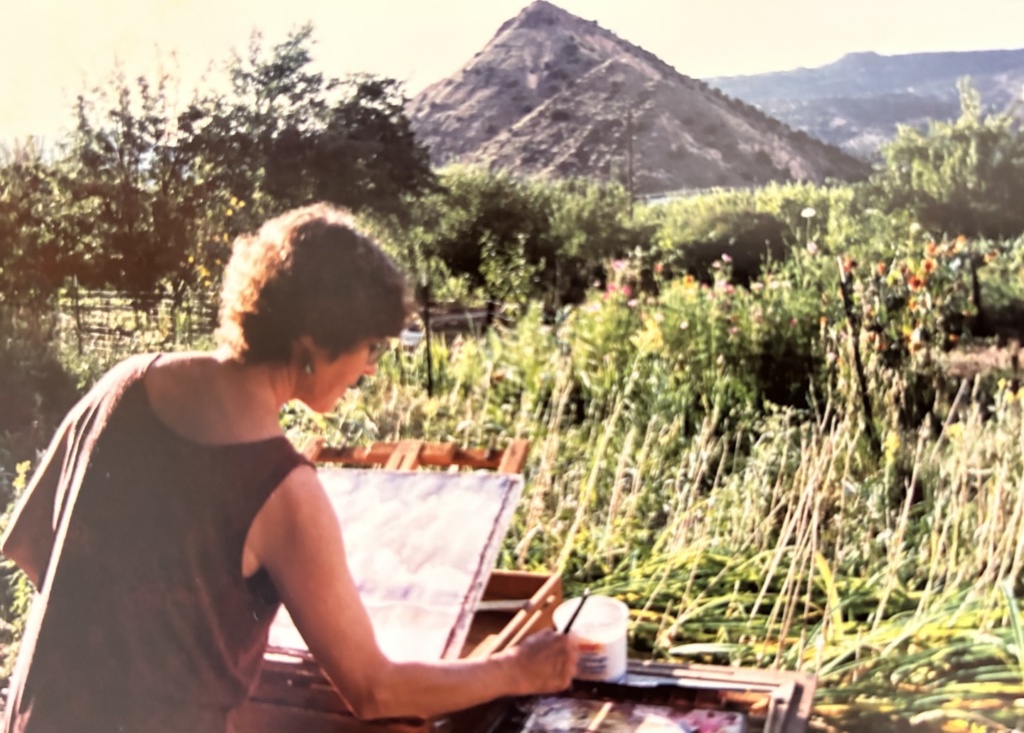
Gayle Fulwyler Smith Painting Pleinair in Dixon, NM
Some of my earliest art lessons came from Gayle Fulwyler Smith when I was growing up in Los Alamos. Our lives intersected in that mountain town. Once, on a backpacking trip she took with our family, I watched her do a pleinair drawing of the mountainside in pencil. I loved how she was able to draw what was in front of her, and she agreed to give me some lessons. We focused on contour drawings, observing objects closely and drawing that point where the edges meet. Sometimes we did ‘blind’ contour drawings, where the eye could tell the hand where to go, without looking at the paper.
Those moments with Gayle had a resonance for me, as today I see that my earliest encounters with art had to do with ‘seeing clearly’, a practice she brought to her art.
The following are excerpts from a letter Gayle recently wrote to me; as well as selections from the book, Voices of Dixon: Oral histories of the Embudo Valley; interviews and editing by Harvey Frauenglass, reproduced with permission by the publisher David Rigsby, 2012.

Gayle Fulwyler Smith painting in Dixon, NM
Gayle’s recollections of early drawing:
I started drawing fairly early, with pencils and papers and whatever tools I had. I remember once I went to West Yellowstone to babysit the two daughters of our physician and his wife. In the fireplace of their cabin there was some charcoal and I discovered that was an interesting thing to draw with. I would go out of my way, then, to find sticks of charcoal. (Later I learned you could buy them in a store all nicely shaped into sticks.) I’d come home from trips with my dad and try to paint some of what I had seen. Watercolor was fast and fairly clean. I don’t even remember where I got the first paints that I had. I didn’t do a lot of that growing up because as the oldest of five I had a lot of responsibilities and work to do, and in the summers and after school as I grew older I had paying jobs. I liked to read and I liked to walk; so if I had extra time, not that I had a lot of extra time, I read a lot.
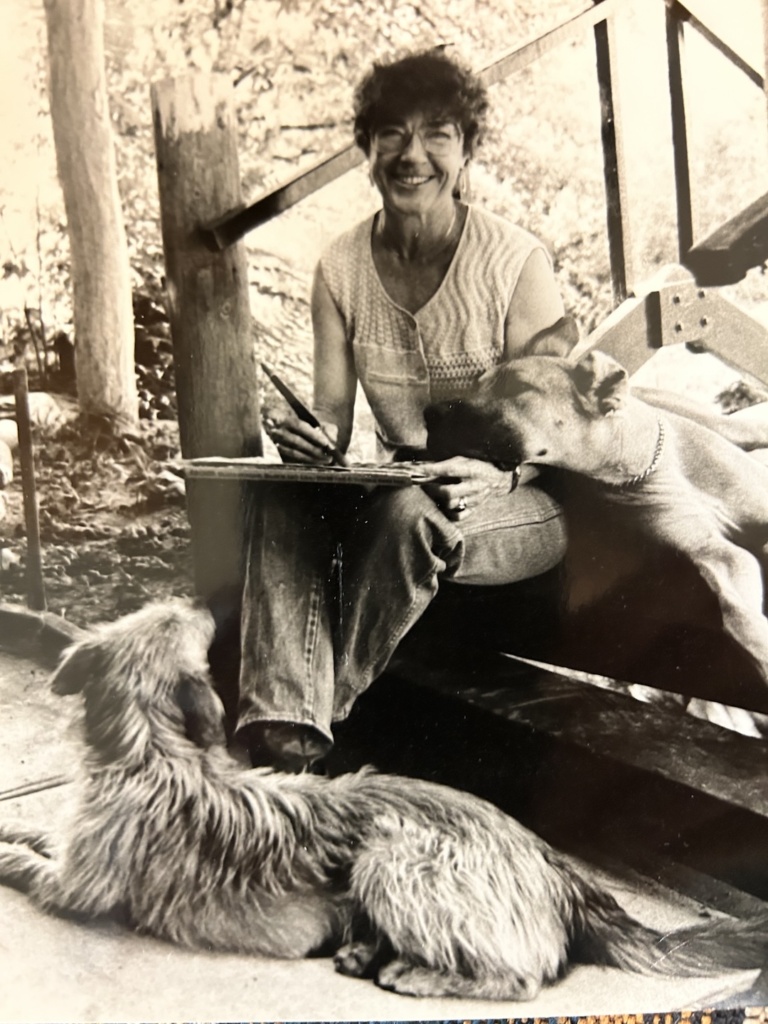
Gayle Fulwyler Smith painting with helpers
First Art Course
My grandmother gave me an important gift around the time I graduated from high school: the “Famous Artist’s Course, a four year correspondence course in commercial art. I worked hard to fit the assignments in between working and keeping house as a wife and a mother. One of the things I learned was to see through forms, to see that all shapes could be reduced to cylinders, squares, triangles and cones. We used these shapes as a basis to draw everything, including people, so one got a good sense of seeing through things, seeing around things, seeing things in the context of the space that they are in. I used these techniques in the various assignments I mailed in for critique. I remember once I was supposed to paint a girl bathing a dog; maybe that was my choice. I completed the course and got a certificate.
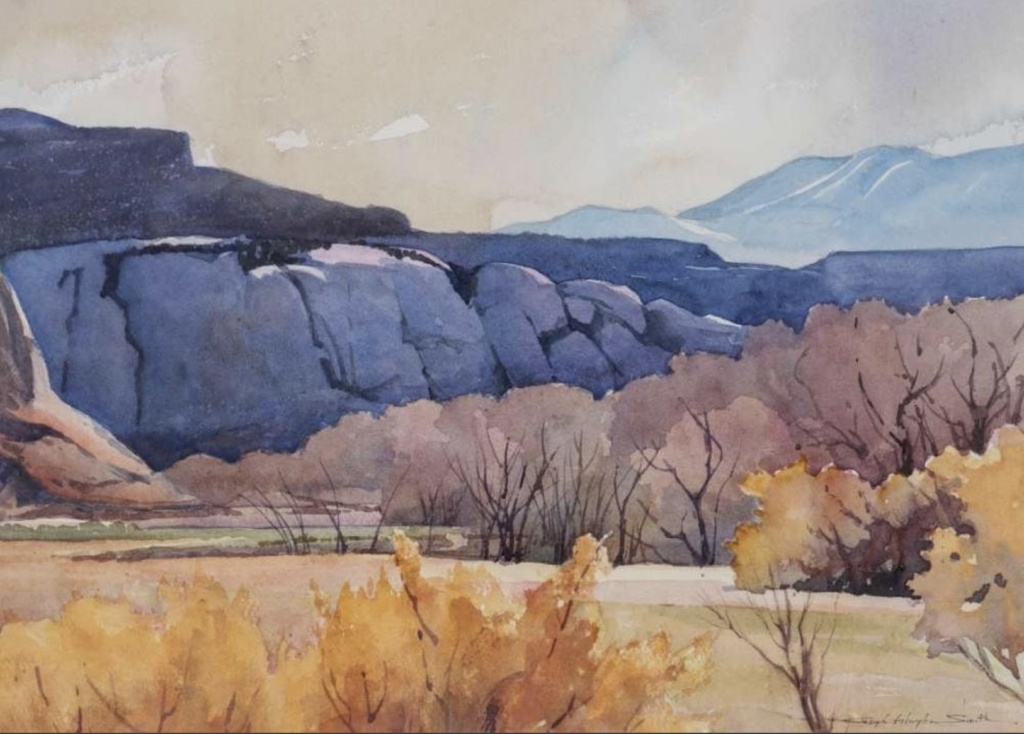
Gayle Fulwyler Smith: South of Moab
A working artist
My first experience working in art was in Alabama. My husband was in ROTC in college. When he graduated he went into the Army as a second lieutenant and for two years he was stationed at Fort McClelland. I worked for the Army on the base as an illustrator. I remember doing cartoons of the Twelve General Orders. That was fun, and the officers liked them and used them for a long time. In the officers’ club they wanted a painting over the bar and so I did a painting of a nude. Unfortunately she looked a lot like Jackie Kennedy. I got a lot of ribbing for that.
After we moved to Los Alamos, I started taking classes at the Los Alamos branch of University of New Mexico. I took literature classes and psychology and several classes in anthropology, I liked them all and especially loved the literature. I remember the first time I brought home a bunch of books. I think it was from a Nobel Prize winning literature class. I had this pile of books and I remember thinking it was just a treasure because when I was growing up so often I heard “we don’t have time to read right now, we have this ironing to do (or this other to do)”. I was in seventh heaven with that pile of books and it was my assignment to read them! There is so much to learn from the great novels–history, psychology, human relationships, all kinds of ideas; I loved that stuff.

Gayle Fulwyler Smith: Three Cows, pen-and-ink
Academic Art Courses
After we lived in Los Alamos for a while, Mack went to Denver to get his PhD. We lived in Denver for two years. I took classes at Denver University and the University of Colorado, some literature but also art courses, and those were very interesting. They were quite different from the Famous Artist’s Course I had taken because this was in the 60’s during the time of some of the pop art and the op art and big canvases by Mondrian. The painting teacher that I had also did work in metal. She would plan a piece and then have someone construct it for her. When I first went into her painting class, and she wanted examples of what we could do; with mine she just kind of shook her head. She said, “See the apple, draw the apple, paint the apple red.” I would go home from that class a lot of times and just cry. She gave me a brush to draw with and a stick with ink so that I wouldn’t get too “tight;” that was going in the opposite direction from that illustrator background that I had had. By the end of the time that I spent with her, though, she really liked what I was doing. I remember her saying, “You’re getting damned good, you know!”
Then I took an oil painting class from her too and did big flat figures that she liked a lot. My introduction to the drawing instructor was the opposite of the introduction to the painting instructor. He said, “You can already draw; what are you doing in here?” But he was very helpful. He said, “I have a friend who has a gallery in Cherry Creek and I think you should take him some of these drawings.” He also looked at some of the paintings I was doing and he encouraged me to take those to his friend, too. I did that and the gallery sold them all.

Gayle Fulwlyer Smith: Three Geese
Watercolors in Los Alamos
I haven’t done those kinds of paintings since and I don’t have any pictures of them. It was sort of the mood of Denver. There was a painter, Will Barnett, who did graceful, realistic paintings with flat colors. I liked his work and it influenced what I was doing at that time. When we came back to Los Alamos I drew and painted my children and did landscapes whenever I could get out. I appreciated watercolor because it’s easy to carry. I would just take water and paper and the colors and sit on a rock.
Another thing that I always enjoyed when I was growing up was being able to get out by myself. Even though I loved my family, there seemed to be a lot of us and I always liked the chance to get away. We had hills behind the house and when I had some time I would go up in the hills and just walk. I remember my mother saying to my dad, “oh you shouldn’t let her go up there, anything could happen”. Dad would say “it’s good for her, let her go”. And I’m really grateful that he did that, because that was important to me; the times that I spent with him, when we were out in the wilderness and it was quiet. Hunting, whether you are hunting with a gun or hunting with a camera, you have to be quiet so I have always kept that feeling of liking to be by myself and painting. As I get older that changes a little; I like company more, painting with other painters. But it is not always possible to schedule that. When I was in Los Alamos a sculptor friend encouraged me to enter the New Mexico Arts and Crafts Fair in Albuquerque. We both got juried in and shared a booth. Then I just kept entering and getting in. I did that show, which is held at the State Fair Grounds in June, and usually the Southwest Arts and Crafts show in November. Besides these big juried fairs, I did other juried shows. The art shows were stimulating and I met a lot of people, both artists and people who bought my paintings. Some have become good friends. And I started entering competitions.

Gayle Fulwlyer Smith: Rinconada Overlook
Workshops and teaching
I also took workshops from people whose work I admired. One was Charles Reid; I took two or three workshops from him. I took workshops with Robert E. Woods and Millard Sheets, both of whom have passed on. Sheets was a colorist and his work was opaque rather than translucent like more traditional water colors. I took workshops with other artists, and I learned something from all of them.
Then I started teaching. And, through teaching I was always learning. I had to consider the questions I might be asked and be prepared to answer them. If I were going to do a demonstration, I usually planned and painted that out before hand, or at least have
good ideas about what I was going to do. I taught for many years; then there came a time when I just got tired of it.
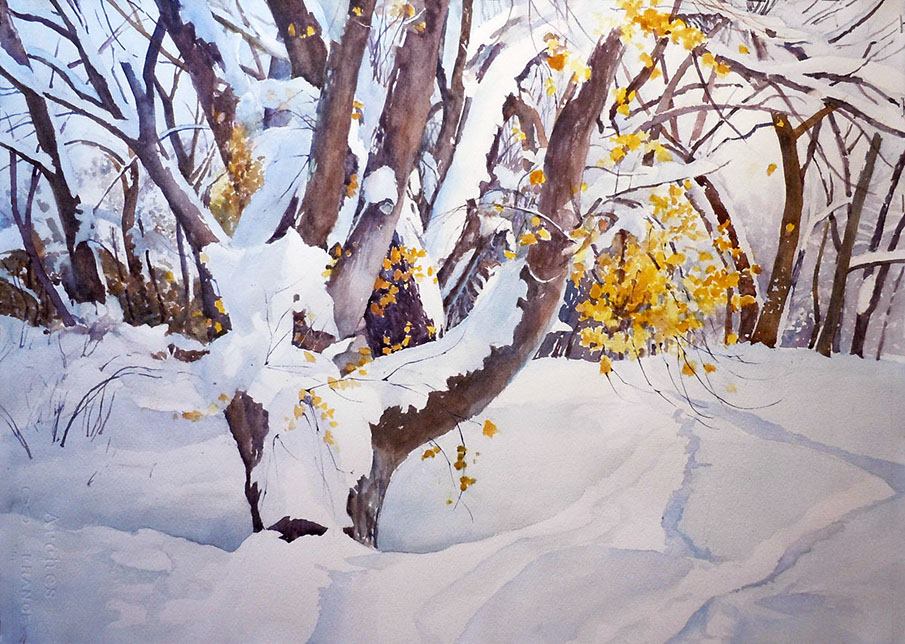
Gayle Fulwyler Smith: Apple Tree in Snow
Los Alamos
Later I worked for Los Alamos Lab as an illustrator. That’s where I guess that commercial art stood me in some good stead but it wasn’t interesting work for the most part. It was mostly graphic art, black and white line drawing, charts and things. The one fun thing I did was go out and paint a watercolor of some buildings and the big Omega bridge over Omega canyon and they used that on the cover of their publicity publication and the papers which they presented for at least three years. Once I did a portrait, a memorial portrait of somebody for a magazine that they were putting out. I did cartoons too. That was certainly more fun than graphs.
Finally I wanted to leave Los Alamos. I had been there twenty-three years. I had taken a writing workshop with Stan Crawford and went to a party at his house in Dixon. Holly Haas, whom I had met at an art fair, was at the party and she happened to have that building in the front for rent. I was working half time in the illustrator’s job, as much as I wanted to work at that. So I made a small apartment in my house to live in half the week and rented out the rest of it. Then I had a studio in Dixon part-time. I went out in the car and did lots of little drawings and paintings in my sketchbook, mainly the adobe houses and the hills and fields of pastoral northern New Mexico.
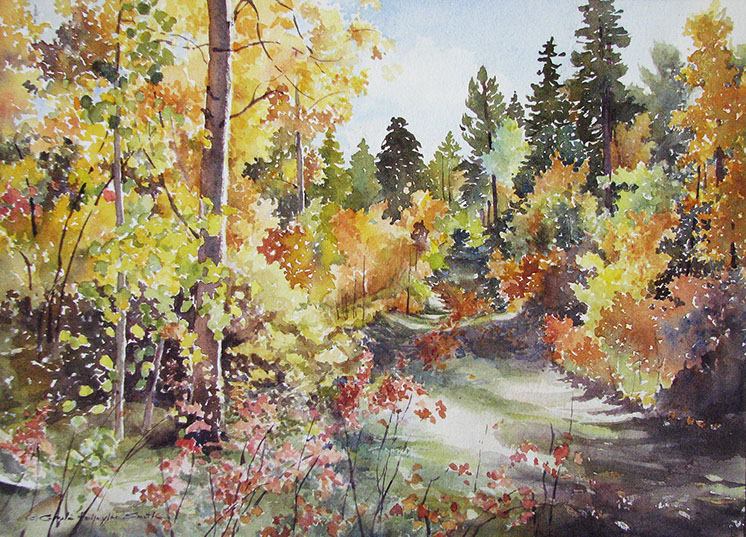
Gayle Fulwyler Smith: Forest Road, Fall
One thing I thought about while we were talking the other day was that in some ways counting so much on the studio tour has good points and not so good points. When I was doing shows I was out there, meeting new people, talking with other artists. If I forgot about or didn’t know about a competition coming up, someone would remind me. Now with the studio tour I’ve put all my eggs in one basket. Part of it, too, is that I was in some galleries, but they began to take 50%, some of them, so I didn’t do as many of them. People need to know who you are; that’s important.
Traveling and Painting
Something else that I wish I’d been able to do more in my life is travel and paint. Money has always been a concern, however; I never felt easy about just taking off to go paint. But when I have gone any place, it has been just wonderful. I went to Mexico with Celeste and Sarita many times and always did painting and sketching and kept journals. I went to Bolivia with my daughter about 10 years ago. We were in La Paz and in Sucre, for about 3 weeks. I did a lot of sketching and took a lot of photographs. I’ve begun to paint more from my photographs for several years now. I’d rather not, but sometimes I need that information and that’s the only way to have it. Harvey and I went to Europe about six years ago. We spent two weeks among the medieval buildings and churches and in the narrow streets of Nuremberg and the farming villages around it, then about a week in Bern (including an excursion to the Jungfrau and the Eiger), and then over a week in Paris. I sketched Notre Dame in plein air in December, and sketched an art student copying a painting in the Louvre. Besides painting and photographing, I loved visiting museums in Bavaria and Bern, and, especially, in Paris.

Gayle Fulwyler Smith: Mammoth Donkeys
Working on location
Many years ago Mack and I went to London and to Spain and I did a lot of drawing and painting. I just carried the sketchbook around and I still have all my sketchbooks. And then cities in the United States, in a lot of the states by car. In New York and Connecticut. I love painting the ocean and I love painting boats. For years I’ve driven up to Idaho to visit my family a couple of times a year. Through northern New Mexico, Colorado, and Utah the landscape has vivid colors and strong formations, especially the desert in southern Utah and around Ghost Ranch and Abiqui Dam in New Mexico. I have painted in the red rocks and the canyon lands around Moab many times. In all seasons so there is always something I want to paint or to photograph on those drives.
I realized a long time ago that a lot of what painting is about for me is being there. That’s why I am less happy about photographing what I want to paint later. When you sit there for a while and you are drawing it or painting it, all of your senses are open to whatever that is. You see it and you feel what the air is like and the light changing and whatever noise there is–water, birds. So that all becomes a part of what you are painting.

Gayle Fulwyler Smith: Road in Canyon De Chelly
One wave at at time
When Harvey and I were in Oregon for four weeks, it rained for 21 days. We swapped houses with a friend in Yachats. She had a comfortable little house about four blocks from the ocean. We had driven up in an Astrovan and we could drive the van close to the cliffs, the cliffs along the ocean, and I’d just sit there and watch the waves come in and watch the ocean there and think how do I do this? How do you do this?! And about that time I remember we were reading a book by Anne LaMott, “Bird by Bird” and what she said was just look at one bird at a time. So I thought, OK, one wave at a time and I ended up doing a series and I was very pleased. They really looked like ocean and felt like ocean and I sold them all as a piece shortly after we got home. But just the experience of the ocean, wherever it is, either in Mexico or on the West Coast or on the East Coast, is wonderful.